Dynamic instability of the Wilkes Subglacial Basin Ice Sheet, East Antarctica
Sep 30, 2026·,,,,,,,,,,,,,,,,,,,,,,,,,,,,,,,,,,, ,,
,,
Matt A. King
Nancy A. N. Bertler
Sridhar Anandakrishnan
Guilhem Barruol
Michael J. Bentley
Xavier Crosta
Poul Christoffersen
Florence Colleoni
Laura De Santis
Carlota Escutia
Johan Etourneau
Dimitris Evangelinos
Fausto Ferraccioli
Nicholas R. Golledge
Matt Harris
Petra Heil
Nicole A. Hill
Indi Hodgson-Johnston
Coen Hofstede
Xiaoxia Huang
Richard Jones
Serena Lagorio
Won Sang Lee
Andrew Mackintosh
Felicity S. McCormack
Robert M. McKay
Maxence Menthon
Taryn Noble
Marilyn N. Raphael
Stephen Rintoul
Martin Siegert
Craig Stevens
Craig Stewart
Chris Stokes
Yusuke Suganuma
Fiorenza Torricella
Yu (Eddie) Wang
Trevor Williams
Chen Zhao
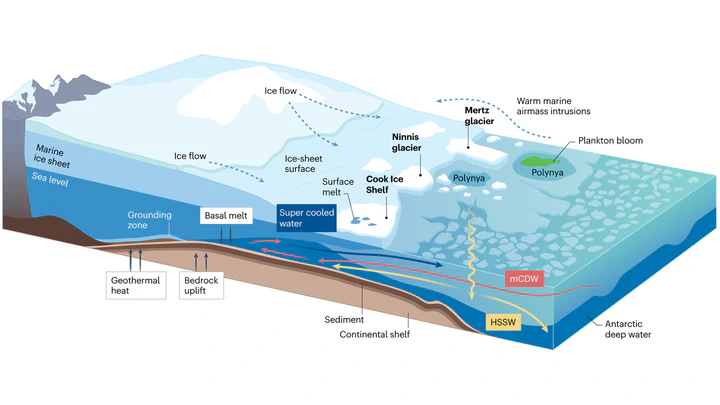 Present-day configuration of the Wilkes Subglacial Basin and its key ice, ocean and bed processes (Fig. 2a of the Review; © Springer Nature Limited 2026).
Abstract
The Wilkes Subglacial Basin (WSB), a marine-based sector of the East Antarctic Ice Sheet, contains enough ice to increase the global-mean sea level by 3–4 m. The geometry of the WSB makes its ice sheet potentially vulnerable to unstable retreat, which could lead to rapidly increasing sea levels as well as meltwater production that could potentially disrupt ocean circulation, carbon cycling and marine ecosystems. This Review explores the climate vulnerability of the WSB in the context of future global warming. Paleo marine-sedimentary and model evidence suggests that substantial WSB ice-sheet retreat occurred during Pliocene and other past warm periods, albeit with uncertain temperature thresholds. Observations show unattributed multidecadal retreat of the grounding line and thinning and collapse of key fringing ice shelves but without clear upstream surface lowering. Projections of ice-sheet extent under future emissions scenarios indicate rapid retreat (up to ~1 km yr⁻¹) beyond bedrock pinning points, but with uncertain timings and the possibility of commitment to multimillennial change during this century. Given the potentially severe consequences of WSB ice-sheet change, a multinational and multiyear fieldwork and modelling programme is essential to reduce projection uncertainty.
Type
Publication
Nature Reviews Earth & Environment (2026)